AI Simplified - Decoding the Jargon
Terms such as prompt engineering, fine-tuning, retrieval-augmented generation (RAG), vector databases, and retrievers often appear together even though they solve different problems. Confusing them can lead to an unnecessarily complex or expensive design.
This post defines the five concepts in plain language, shows where each one fits, and compares the main trade-offs without assuming prior AI experience.
Navigate this post
Prompt Engineering
The input text or instructions you submit to a Large Language Model (LLM) such as ChatGPT or Gemini are called prompts. Prompt engineering is the process of structuring, refining, and contextualizing these inputs to guide the model toward higher quality, more accurate outputs without altering the underlying model parameters.
Rather than relying on vague requests, prompt engineering provides explicit context, constraints, and output formatting rules. For example, instead of asking "Write about dogs," a engineered prompt specifies persona, word limit, and thematic focus:
Act as a veterinary historian. Write a 200-word paragraph detailing the historical transition of dogs from working companions to domestic pets in 19th-century Europe.
Prompting Best Practice
Provide examples when the expected pattern is hard to describe, and state structural requirements such as a JSON schema. Clear instructions can reduce formatting errors, but they cannot guarantee factual output.
The diagram below contrasts standard simple prompting with an iterative prompt engineering workflow:
---
title: "Prompting vs Prompt Engineering Workflow"
---
flowchart TB
    accTitle: Prompting and prompt engineering workflows
    accDescr: Simple prompting sends a basic instruction directly to the model, while prompt engineering adds context, constraints, and examples.
    SubGraph1["Simple Prompting"]
    SubGraph2["Prompt Engineering"]

    subgraph SubGraph1 ["Simple Prompting"]
        A1["Raw User Input"] --> B1["Basic Prompt"]
        B1 --> C1["Direct Output"]
    end

    subgraph SubGraph2 ["Prompt Engineering Protocol"]
        A2["Raw User Input"] --> B2["Structured Context & Rules"]
        B2 --> C2{"Evaluate Response"}
        C2 -->|"Iterate & Refine"| B2
        C2 -->|"Pass Criteria"| D2["Optimized Output"]
    end
While prompt engineering requires no infrastructure changes, model output quality remains bounded by the pre-trained knowledge base of the base LLM.
Fine-tuning
Fine-tuning is the process of taking a general-purpose pre-trained LLM and continuing its training on a specialized dataset. This process permanently alters the internal weights of the neural network, adapting the model to specific domain terminology, stylistic requirements, or complex task patterns.
Think of fine-tuning as sending a general medicine graduate to complete a specialized residency in cardiology. While the base model understands general language mechanics, fine-tuning teaches it specialized domain mechanics. For instance, a law firm requiring daily drafting of non-disclosure agreements can fine-tune a model on hundreds of curated, high-quality contract templates.
Fine-Tuning Dataset Example
Fine-tuning datasets typically use JSON-L formatting containing paired instruction and response examples:
{"messages": [{"role": "system", "content": "You are a legal assistant specializing in NDA drafting."}, {"role": "user", "content": "Draft a confidentiality clause for software IP."}, {"role": "assistant", "content": "Section 4.1 Confidential Information: Recipient agrees to hold all proprietary code in strict confidence..."}]}
The following diagram illustrates how raw training examples modify the base model into a specialized domain expert:
---
title: "Fine-Tuning Model Adaptation Pipeline"
---
flowchart TB
    accTitle: Fine-tuning model adaptation pipeline
    accDescr: A domain-specific dataset updates a pre-trained language model so it can produce outputs tailored to that domain.
    A["Pre-trained Base LLM"] --> B["Supervised Fine-Tuning Step"]
    C["Domain Specific Dataset"] --> B
    B --> D["Fine-Tuned Specialized Model"]
    E["User Query"] --> D
    D --> F["Domain Compliant Output"]
Fine-tuning excels at teaching models specialized formatting, tone, and task execution, but it does not serve as an efficient mechanism for inserting real-time or frequently changing knowledge.
Retrieval-Augmented Generation (RAG)
Retrieval-Augmented Generation (RAG) combines external document search with LLM text generation. Instead of relying solely on the static memory embedded inside model weights, RAG retrieves relevant factual excerpts from private databases or live documents and appends them directly into the context window sent to the model.
Consider a local pizzeria using an AI ordering assistant. Rather than retraining the AI model whenever menu items or prices change, a RAG system looks up current menu data from a database dynamically when a customer asks a question.
Why RAG Beats Pure Generation for Fresh Data
A deployed base model does not learn a changed policy merely because the policy file changed. RAG keeps the searchable knowledge source separate, so a team can update that source without retraining the model. The new content still needs indexing and retrieval tests.
The architectural comparison below highlights the structural differences between standard generation and RAG pipelines:
---
title: "Traditional LLM Generation vs RAG Architecture"
---
flowchart TB
    accTitle: Standard language model generation and RAG
    accDescr: Standard generation relies on the model alone; RAG first retrieves relevant documents and includes them as context for the answer.
    subgraph Standard ["Standard Generation"]
        A1["User Query"] --> B1["Static Base LLM"]
        B1 --> C1["Unverified Output"]
    end

    subgraph RAG ["RAG Architecture"]
        A2["User Query"] --> R2["Retriever Component"]
        R2 <--> V2["Vector Storage Engine"]
        V2 <--> D2["External Knowledge Base"]
        R2 -->|"Extracted Context"| B2["LLM Generator"]
        A2 --> B2
        B2 --> C2["Response with Retrieved Context"]
    end
RAG can give the model more relevant and current context, but retrieval can miss the right passage and the model can still misstate it. Citation behavior must be designed and tested separately.
Vector Databases
A vector database is a specialized storage engine engineered to store, index, and query unstructured data through mathematical representations called embeddings. Unlike traditional relational databases that match exact text strings, vector databases evaluate semantic similarity between concepts.
When text such as PDF pages or support chats is indexed, an embedding model converts each segment into a vector. The model is trained so related text often receives nearby vectors. Similarity is useful but imperfect: wording, language, chunk size, and the embedding model can change the result.
Vector Indexing Performance
Many vector indexes use approximate nearest-neighbor methods such as Hierarchical Navigable Small World (HNSW). They trade some recall for faster search. Latency depends on index size, hardware, parameters, and filters, so measure it on the target workload.
The graphic below visualizes how text concepts cluster by semantic meaning within multi-dimensional embedding space:
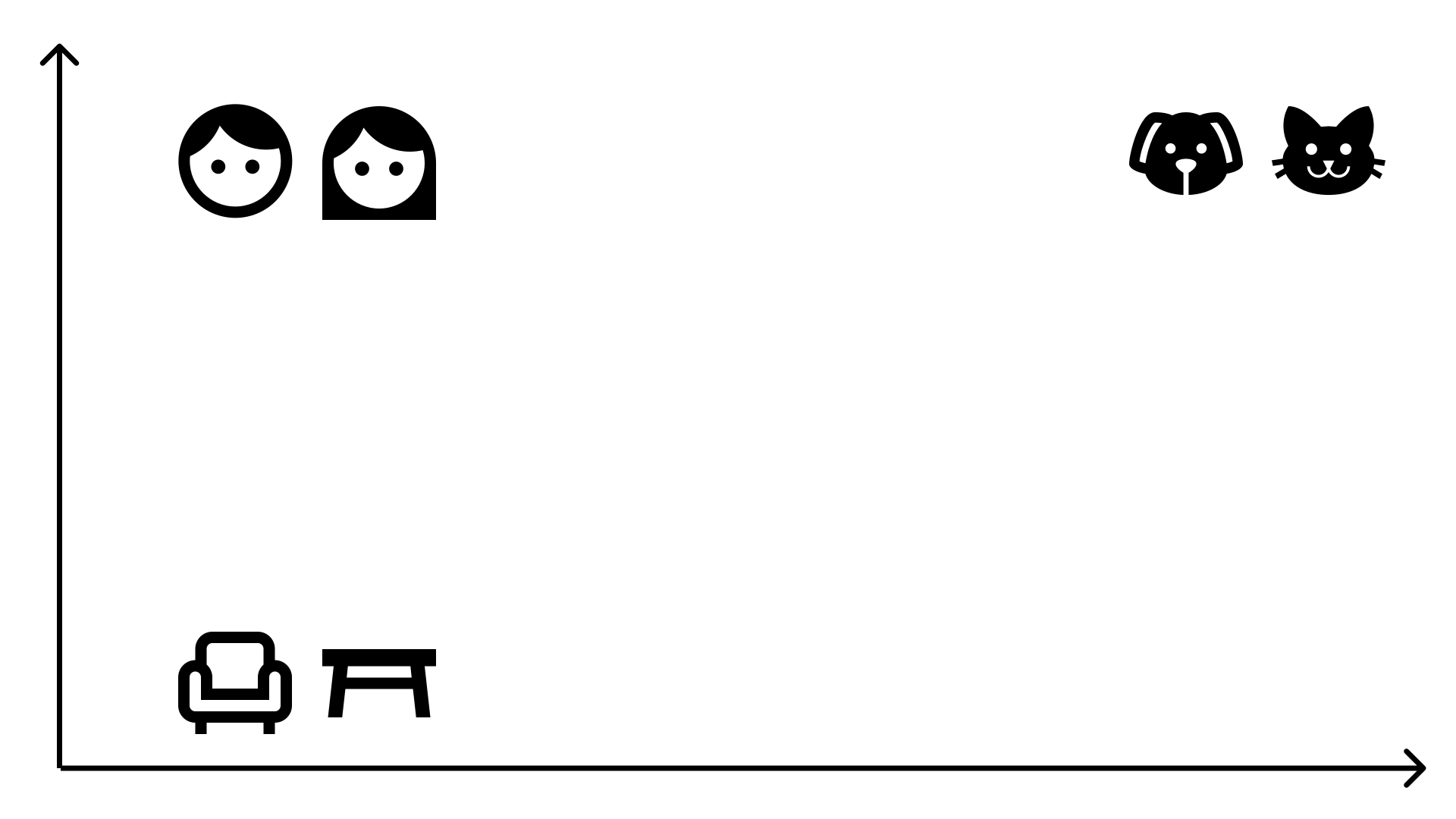
Vector search can be provided by a specialized database or added to a relational database. Choose based on scale, filters, operational constraints, and measured retrieval quality rather than assuming RAG requires a separate vector product.
Retrievers
The retriever selects information related to a question. In a vector-based system it may embed the query, run similarity search, filter or rerank results, and select document chunks. Not every retriever uses every stage.
The retrieval execution protocol follows three structured phases:
- Semantic Vector Search: Translates user query into a vector and finds nearest neighbor document vectors.
- Optional Re-Ranking and Scoring: Applies a second model or rules when the system needs to reorder the initial results.
- Context Assembly: Packs top-ranked excerpts into the final prompt payload sent to the LLM generator.
Context Window & Relevance Caveat
Too many chunks can crowd the model input with irrelevant text. Set result count and thresholds from retrieval tests; one strict threshold does not work equally well for every question.
The sequential flow below illustrates how a retriever processes queries into curated LLM context:
---
title: "Retriever Query Execution Protocol"
---
flowchart TB
    accTitle: Retriever query execution process
    accDescr: The system embeds a query, finds and reranks similar records, assembles context, and sends that context to the language model.
    A["Raw User Query"] --> B["Generate Query Vector"]
    B --> C["Query Vector DB Index"]
    C --> D["Fetch Top-K Vector Matches"]
    D --> E["Cross-Encoder Re-Ranking"]
    E --> F["Assemble Context Prompt"]
    F --> G["Send to LLM Engine"]
The retriever controls which evidence reaches the model, so retrieval errors become answer errors. Evaluate whether it finds the required passage, not only whether the final answer sounds fluent.
Comparing AI Architecture Approaches
Selecting the right combination of AI techniques depends on data recency, budget constraints, and task complexity. The comparative table below outlines the core attributes of each strategy:
| Architectural Approach | Primary Purpose | Knowledge Recency | Implementation Effort | Typical Latency Impact |
|---|---|---|---|---|
| Prompt Engineering | Direct model instruction framing | Base model cutoff | Minimal (Hours) | +0 ms |
| Fine-Tuning | Domain style & schema adaptation | Static training snapshot | High (Days/Weeks) | +0 ms |
| RAG & Retriever Pipeline | Dynamic factual context injection | Real-time live data | Moderate (Days) | +50 ms |
Prompt engineering provides immediate value with zero latency penalty but is limited by pre-trained model knowledge. Fine-tuning adjusts internal model behavior for specialized tasks, while RAG dynamically injects live context at the cost of a minor retrieval latency overhead.
-
Prompt Engineering
Refines model outputs using targeted context and instructions without modifying weights or infrastructure. -
Fine-Tuning
Adapts internal model weights on domain-specific datasets to enforce custom style, tone, and strict output schemas. -
RAG Architecture
Combines live data retrieval with generative models to answer queries using up-to-date private documents. -
Vector & Retriever Pipeline
Converts text to mathematical embeddings and performs similarity searches to feed relevant context into LLMs.
Conclusion
Understanding the distinctions between prompt engineering, fine-tuning, RAG, vector databases, and retrievers allows teams to design efficient AI solutions:
- Start with prompt engineering to evaluate base model capabilities and establish baseline performance.
- Implement RAG and vector databases when your application demands access to real-time, private, or rapidly changing document stores.
- Use fine-tuning when repeated examples need to change model behavior, terminology, or task performance. It can improve consistency but does not guarantee a format.
By matching your technical requirements to the appropriate AI architecture pattern, you avoid unnecessary complexity and build reliable, scalable Generative AI systems.
References and further reading
Open the complete reference catalog
Primary Sources
- Lewis et al., "Retrieval-Augmented Generation for Knowledge-Intensive NLP Tasks" (2020)
- OpenAI, "Prompt Engineering Guide"
- Pinecone Documentation, "Vector Databases Overview"
Related Site Guides
- RAGify Architecture Guide - Practical RAG pipeline implementation
- Movie Recommendation Bot - Vector embeddings in practice