Hashing MCP Server: Cryptographic Hashing for Your LLM
Large language models (LLMs) generate text; they should not be trusted to calculate an exact file digest from memory. A digest is the fixed-length value produced by a hash function for a specific input.
I built the Hashing MCP Server so an AI assistant can delegate that calculation to Python code through Model Context Protocol (MCP). This post shows how the tool exposes MD5 and SHA-256 operations, how a client calls them, and why MD5 is useful for compatibility checks but not for security-sensitive integrity guarantees.
Navigate this post
What is the Model Context Protocol?
Large language models can explain a hashing algorithm or write code that uses one. They do not execute that algorithm merely by predicting a digest in text, so a plausible-looking value may still be wrong.
The Model Context Protocol (MCP) addresses this limitation by standardizing how language models communicate with external tools and local application servers. Instead of relying on internal token prediction to compute data, the LLM constructs a structured JSON request and delegates the execution to a dedicated server process running locally or remotely.
If you are new to Model Context Protocol and agentic architectures, these background guides offer introductory context:
Architecture of the Hashing MCP Server
The Hashing MCP Server is a small process that exposes hashing operations to compatible clients through standard input and output streams (stdio). It registers two tools with the host:
calculate_md5: Accepts a raw text string and returns its 128-bit MD5 hex digest.calculate_sha256: Accepts a raw text string and returns its 256-bit SHA-256 hex digest.
When you send a prompt requesting a hash computation in an MCP-enabled application - such as VS Code Copilot Chat or Claude Desktop - the host client identifies the registered tool, passes the argument payload to the local server, and receives the computed checksum.
| Algorithm | Digest Size (Bits) | Collision Resistance | Recommended Use Case |
|---|---|---|---|
| MD5 | 128 | Broken for collision resistance | Matching a legacy checksum when security is not the goal |
| SHA-256 | 256 | Strong collision resistance | File or message integrity when the expected digest comes from a trusted source |
SHA-256 has strong collision resistance for current integrity uses. MD5 remains useful only where an existing system requires that checksum; an attacker can deliberately create collisions. Neither raw MD5 nor raw SHA-256 is suitable for password storage - use a password-hashing function such as Argon2id, scrypt, or bcrypt.
Key Features and Capabilities
-
Deterministic Accuracy
Computes exact MD5 and SHA-256 digests using standard Pythonhashlibexecution rather than probabilistic LLM approximations. -
Tool Delegation
Runs the calculation in a dedicated process instead of asking the language model to predict the result. -
Direct Client Integration
Connects directly with popular MCP-compatible chat interfaces including VS Code Copilot Chat and Claude Desktop. -
Open Protocol Reference
Serves as an accessible reference implementation for developers learning to build custom tools with the Model Context Protocol SDK.
Installation and Client Setup
You can run the server directly using uvx (part of the uv Python package manager), via pip, or inside a Docker container.
To configure the server in Claude Desktop, add the following JSON entry to your claude_desktop_config.json configuration file:
Prerequisite Requirements
Ensure you have uv installed on your system path before running the uvx command. Alternatively, you can run the pre-built Docker image using docker run -i --rm kunalpathak13/hashing-mcp-server.
Demonstration and Walkthrough
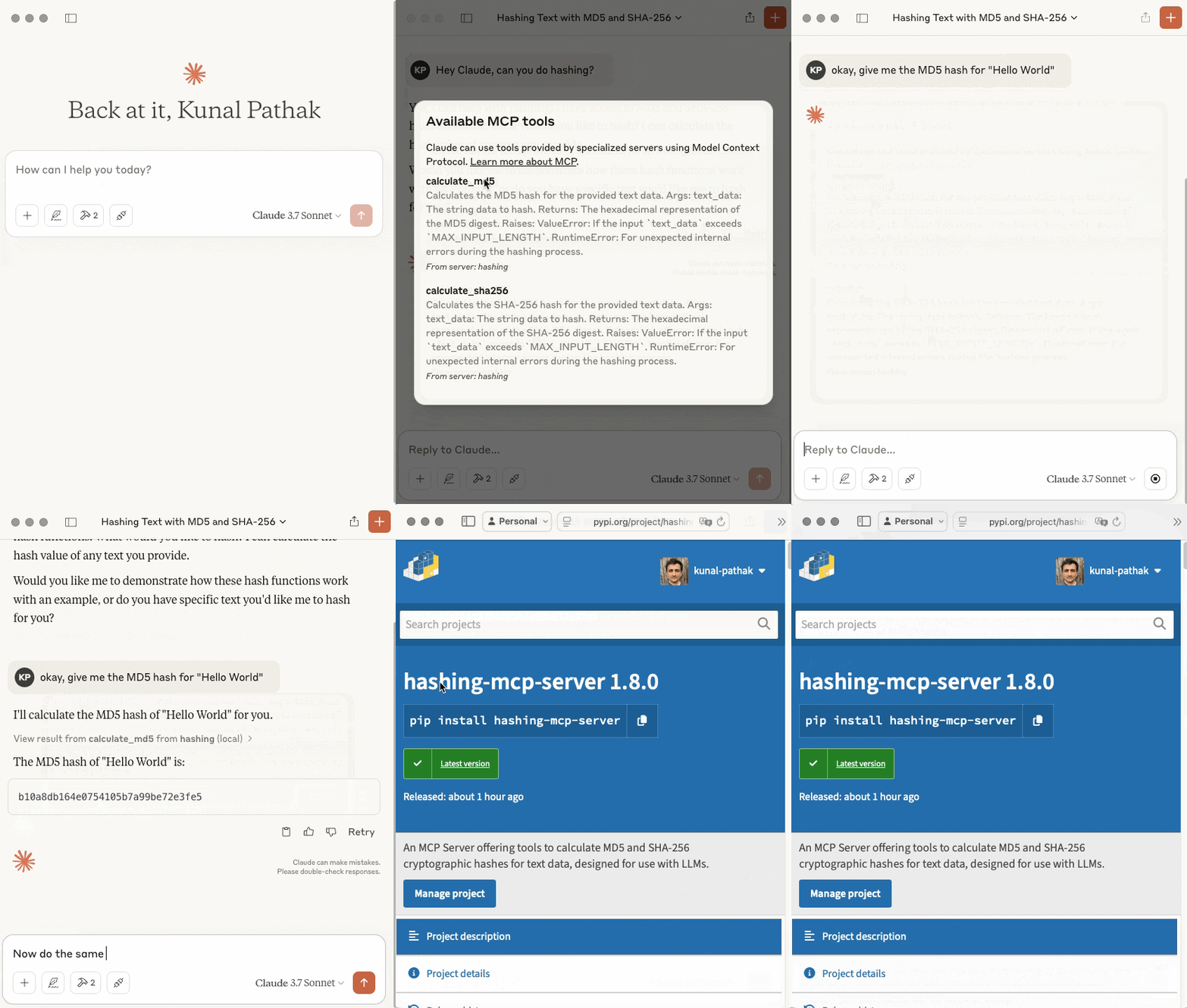
Once configured, your AI assistant automatically detects the available hashing tools. When you ask the assistant to generate a hash digest for a target string, it constructs a tool invocation request, receives the verified result from the server process, and displays the exact hash output.
Here is a recording of the server executing hash requests in Claude Desktop:
Learn More, Contribute, and Explore MCP
The Hashing MCP Server project provides multiple resources for integration, package distribution, and source exploration:
- Understanding Model Context Protocol & Agentic AI - Background conceptual guide
- Step-by-Step Developer Tutorial - Guide to building an MCP server from scratch
- PyPI Package Repository - Official Python package details
- Docker Hub Repository - Containerized image deployment
- GitHub Source Repository - Open-source codebase and issue tracker
Conclusion
The Hashing MCP Server delegates a deterministic calculation to Python instead of asking a language model to predict the output. For the same input bytes and algorithm, the tool returns the same digest. Callers must still agree on text encoding and whether they are hashing text or raw file bytes.
Future versions could add SHA-512 or BLAKE3. MD5 should remain clearly marked as a compatibility option, while security-sensitive workflows should choose an algorithm and verification process suited to their threat model.
References and further reading
Open the complete reference catalog
Primary Sources
- Model Context Protocol Specification
- hashing-mcp-server on PyPI
- MCP Server for Hashing GitHub Repository